Sustainable Procurement Policy
Arcadyan updated its Sustainable Procurement Policy at the end of 2025. Based on supply chain due diligence, the policy integrates UNGC, RBA, OECD, UNGP, and ISO 20400 guidelines. It applies to Arcadyan's headquarters, R&D centers, and overseas manufacturing, extending to suppliers, contractors, and business partners. The Sustainability Office plans and reviews the policy, the Sustainability Executive Taskforce tracks implementation, and the Sustainability Development Committee reports progress to the Board of Directors for ultimate oversight.
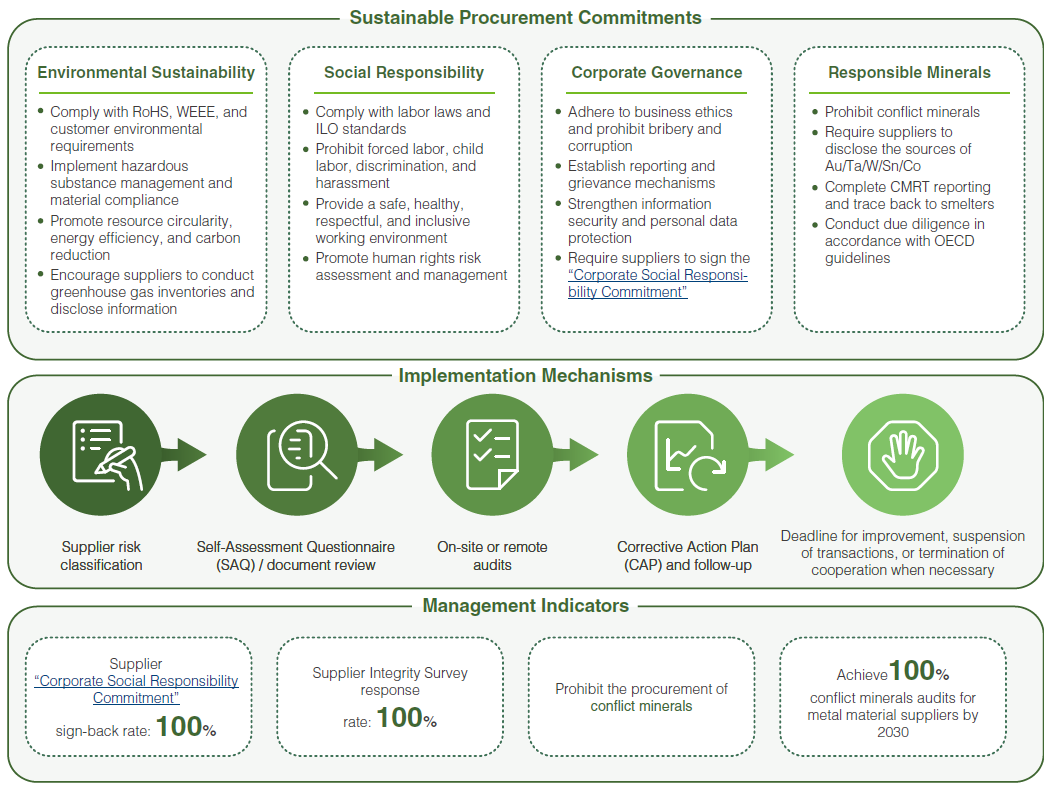
Arcadyan integrates its Sustainable Procurement Policy into new supplier evaluations, regular performance appraisals, and audit processes, implementing risk-tiered management based on location, industry, procurement value, and ESG risks. For highrisk or non-compliant suppliers, the Company intensifies oversight through Supplier Self-Assessment Questionnaires (SAQ), document reviews, on-site or remote audits, and Corrective Action Plan (CAP) tracking. In cases of material violations, Arcadyan reserves the right to enforce time-bound remediation, suspend transactions, or terminate partnerships.
Supplier Sustainability Codes and Commitment Management
Since 2021, Arcadyan has embedded environmental and social clauses into purchase orders, mandating supplier compliance with local and international standards. All products and services must strictly comply with relevant laws, treaties, and directives, including the Montreal Protocol, WEEE, RoHS, REACH, conflict minerals regulations, and general product safety standards. Concurrently, suppliers must adhere to the information security, anti-bribery, and corporate social responsibility requirements outlined in Arcadyan's supplier policies.
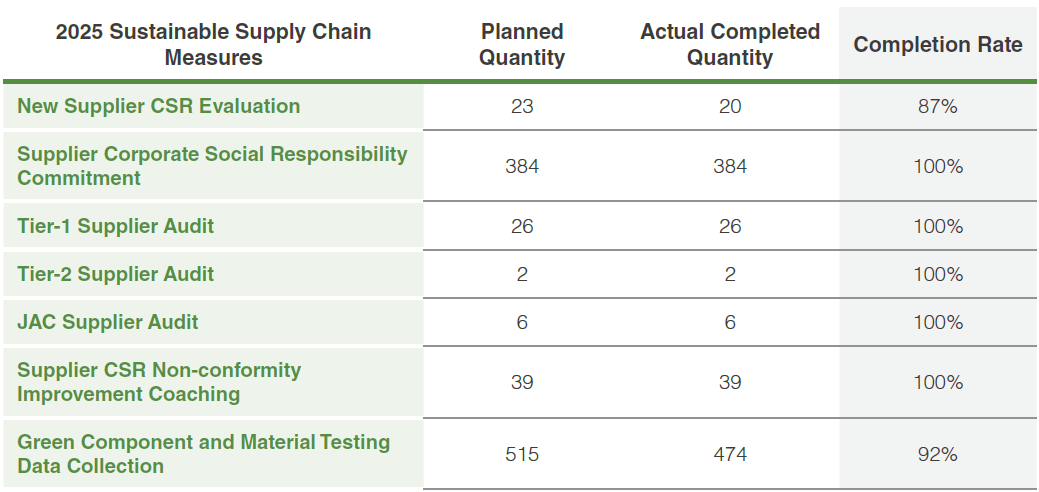
By linking sustainability to transactional terms, Arcadyan embeds environmental compliance, human rights, ethics, and information security into supplier performance obligations, strengthening procurement risk control. To enhance supplier ESG resilience, the Company added information security clauses to its updated Supplier CSR Commitment Letter, which spans seven dimensions: governance, labor rights, occupational health and safety, environmental protection, management systems, ethics, and grievance mechanisms. In 2025, Arcadyan achieved a 100% completion rate, with all 384 suppliers signing and returning the commitment.
Supply Chain Human Rights Management
Arcadyan requires suppliers to comply with local labor laws and international human rights standards. The Supplier Corporate Social Responsibility Commitment Letter explicitly prohibits child labor, forced labor, human trafficking, discrimination, and mistreatment, while ensuring employees' rights to freedom of association, reasonable working hours, fair wages and benefits, and a safe and healthy working environment. To address international supply chain human rights regulations and strengthen forced labor risk management, Arcadyan incorporated the U.S. Uyghur Forced Labor Prevention Act (UFLPA) requirements into the Commitment Letter since 2024. Suppliers are prohibited from using materials, products, or services involving forced labor, human rights violations, or high-risk sources. The Company mitigates these risks through supplier questionnaires, declaration documents, supply chain traceability, and risk identification mechanisms.
Arcadyan incorporates human rights risks into its supplier sustainability risk assessment and audit processes. Enhanced scrutiny is applied to high-risk regions, industries, or supplier types. If any supplier is found to violate labor rights, engage in forced labor, or fail to comply with Arcadyan's supplier code of conduct, the Company requires the supplier to submit an improvement plan and continuously monitors progress. In serious cases, measures such as suspension of transactions or termination of cooperation may be implemented to strengthen supply chain human rights risk control.
New Supplier Onboarding and Assessment
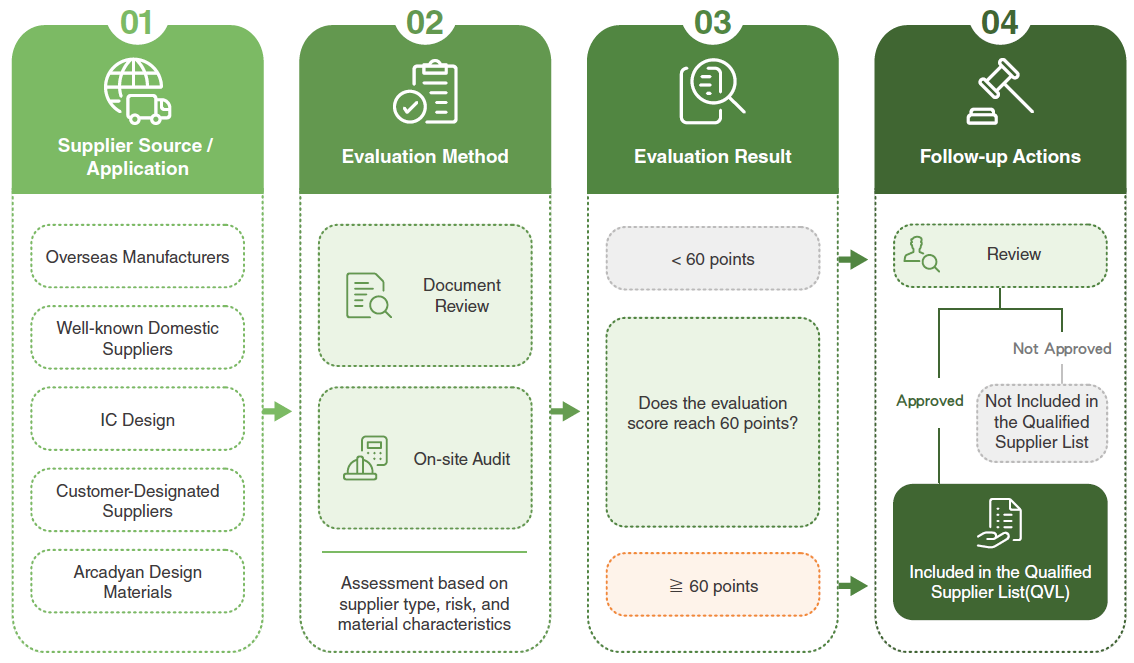
To ensure new suppliers meet Arcadyan's quality, technical, compliance, and sustainability standards, the Company has established a rigorous new supplier selection process. The Supplier Evaluation Form integrates four primary dimensions: quality, environment, engineering technology, and Corporate Social Responsibility (CSR). Additionally, candidate suppliers must provide relevant supporting documentation and sign the Supplier Corporate Social Responsibility Commitment Letter as mandatory prerequisites for admission. Arcadyan progressively elevates ESG weight in procurement decisions, with ESG metrics accounting for 23% of the total evaluation across five dimensions: environment, labor rights, safety, ethics, and grievances. Only suppliers meeting the designated score threshold are placed on the Qualified Vendor List (QVL). In 2025, the Company evaluated 23 new suppliers; among them, three were deferred due to insufficient documentation and required to submit supplementary evidence.
Supplier Sustainability Risk Assessment
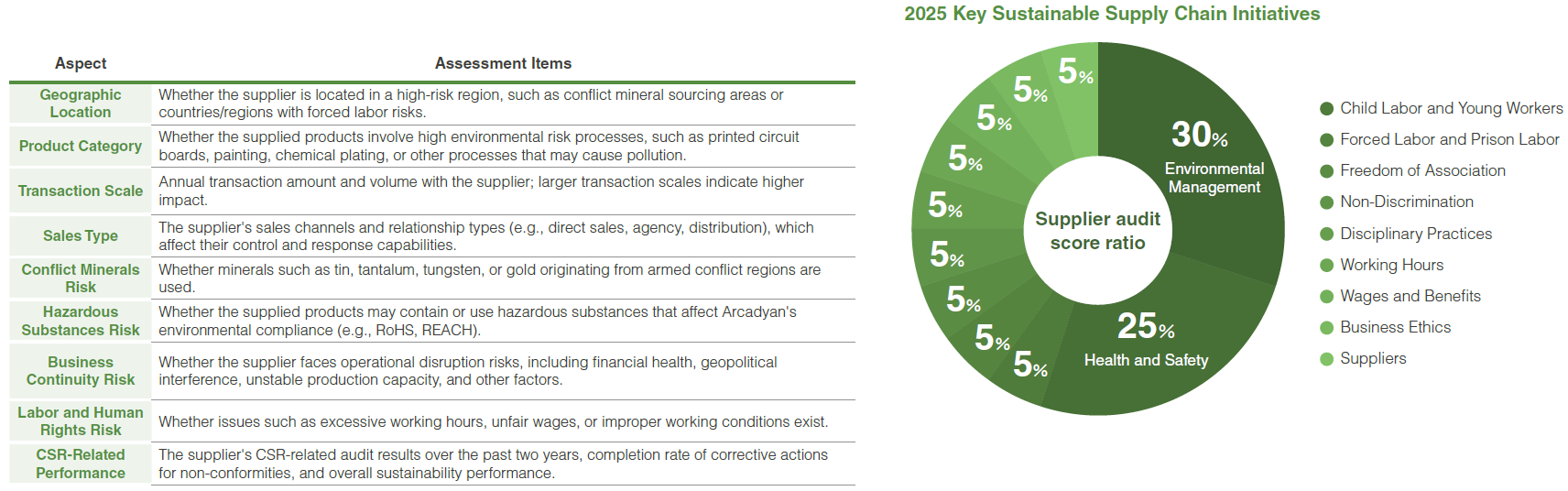
To strengthen risk control, Arcadyan implements risk-tiered management based on supplier location, industry, procurement value, and ESG risks. Integrating audit records from the past two years, the comprehensive evaluation spans nine dimensions: geographic location, product category, transaction scale, sales model, conflict minerals, hazardous substances, business continuity, labor rights, and CSR performance. Arcadyan applies differentiated measures, intensifying reviews, audits, and corrective tracking for medium- and high-risk suppliers, while utilizing these outcomes to guide subsequent supplier coaching, procurement decisions, and partnership management.
During its 2025 assessment of 377 suppliers, Arcadyan identified 1 high-risk (0.27%) and 36 medium-risk vendors, completing all reviews per standard procedures. The high-risk vendor, a customer-directed material supplier, exhibited quality and ESG vulnerabilities that threatened product stability and supply chain sustainability. Consequently, Arcadyan immediately suspended transactions with this supplier to mitigate operational and sustainability risks.
Supplier Auditing
In alignment with the Responsible Business Alliance (RBA) Code of Conduct, Arcadyan has developed a Supplier CSR Audit Checklist to perform document reviews and onsite audits for high-risk or key suppliers. The audit covers labor, health and safety, environment, ethics, management systems, and grievance mechanisms. Environmental management and occupational health and safety account for 55% of the total score, with the remaining categories making up 45%. In 2025, Arcadyan conducted audits on 26 Tier 1 suppliers selected from the medium risk list, achieving a 100% completion rate. To meet customer requirements, the Company also completed on-site audits and corrective guidance for 2 Tier 2 suppliers, further strengthening supply chain sustainability, compliance, and risk management.
Supplier Coaching
Arcadyan regards supplier coaching as a key measure to enhance sustainable performance across the supply chain. The Company provides regular follow-up and improvement guidance for nonconformities identified during Corporate Social Responsibility (CSR) audits. In 2025, Arcadyan assisted 39 suppliers in resolving CSR-related issues, with the main improvement areas being "Health and Safety," "Environmental Management," and "Working Hours and Overtime," accounting for approximately 70% of total non-conformities. Through this tracking and coaching mechanism, Arcadyan helps suppliers strengthen their sustainable management capabilities and reduce potential risks in occupational safety, environmental compliance, and labor rights.
In environmental management, Arcadyan has developed a professional green information platform that provides the latest international environmental regulations and compliance information. This helps suppliers track regulatory changes, maintain compliance, and monitor document uploads and updates, thereby enhancing supply chain compliance and sustainable management effectiveness. Arcadyan actively participates in customer-initiated Sustainable Development Programs (SDP), guiding suppliers to adopt Responsible Business Alliance (RBA) standards. The two-year program covers 10 ESG dimensions—including sustainable strategy, management systems, stakeholder engagement, resource and environmental management, lifecycle thinking, labor practices, human rights, and supplier development—to help suppliers build comprehensive sustainable management systems. In 2025, five suppliers achieved "Silver Grade" certification, while all six suppliers that underwent JAC audits successfully completed corrective actions, further strengthening supply chain capabilities in labor, health and safety, environment, business ethics, and management systems.
Outstanding Supplier Recognition
Arcadyan encourages partners to continuously improve in quality, delivery, service, environmental protection, and social responsibility through its Outstanding Supplier Recognition program. The evaluation criteria encompass incoming material quality, customer complaints, improvement of non-conformities, service coordination, CSR performance, ESG on-site audits, JAC audits, and supply chain carbon reduction
results. In 2025, Arcadyan presented the "Outstanding Supplier" and "Best Carbon Reduction" awards to a total of 11 outstanding partners. This recognition encourages suppliers to continuously enhance their quality, service, and sustainable management capabilities, working together with Arcadyan to build a resilient and sustainably competitive supply chain.
( Learn More: Arcadyan Honors Outstanding Suppliers to Drive Sustainability Together)
Go Green with Arcadyan Carbon Reduction Project
In response to the global net-zero transformation, the EU Carbon Border Adjustment Mechanism (CBAM), and escalating customer demands for supply chain decarbonization, Arcadyan views supplier carbon reduction as a pivotal strategy for achieving its SBTi and Scope 3 targets. Given that upstream supply chains and product lifecycles represent the primary drivers of Arcadyan's carbon footprint, effective supplier carbon management is paramount to realizing its net-zero ambitions. To drive low-carbon transformation across the value chain, Arcadyan launched the "Go Green with Arcadyan" supply chain decarbonization project in 2023. The initiative helps key suppliers build capabilities in greenhouse gas inventories, product carbon footprints, and carbon reduction strategies through training, guidance, technical exchanges, and progress tracking, thereby enhancing supplier carbon management maturity and expanding decarbonization impact across the value chain.
Project Implementation Steps
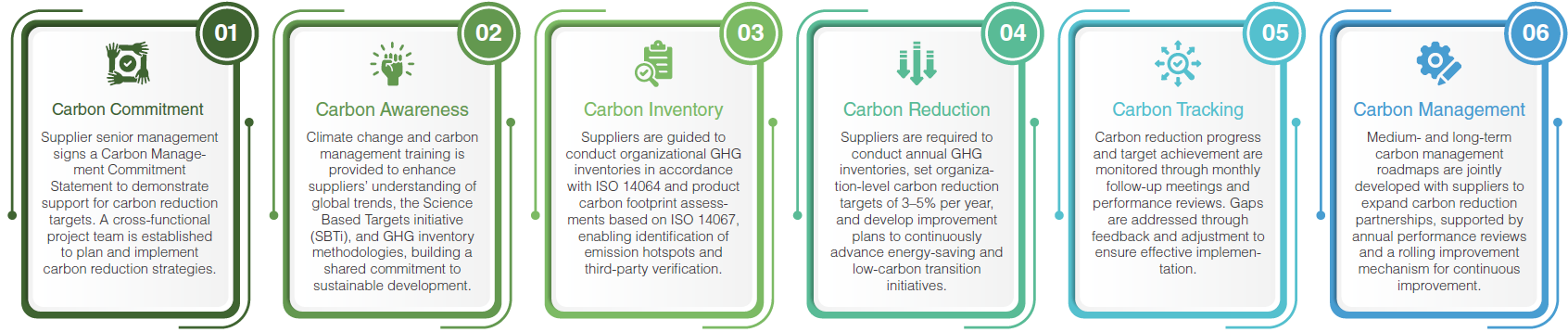
Through the Go Green with Arcadyan project, Arcadyan supports suppliers in building carbon reduction capabilities through system development, technical support, and external partnerships.
Go Green 1.0 Achievements
Launched in October 2023, the Go Green 1.0 project initially invited 14 key high-carbon suppliers across six major component categories—adapters, cables, casings, connectors, heat sinks, and printed circuit boards. Through systematic coaching, these suppliers have built carbon management capabilities and implemented reduction actions. The cumulative achievements are as follows:
- Organizational Level (Scope 1+2):11 suppliers completed ISO 14064 verification; 7 installed solar power systems; and 4 purchased green electricity certificates, achieving cumulative carbon reductions of 95,302 tCO2e through equipment upgrades, smart energy management, and waste heat recovery.
- Product Level (Scope 3):5 suppliers obtained ISO 14067 product carbon footprint certification. Product lightweighting, miniaturization, PCR materials, and optimized packaging and logistics achieved cumulative carbon reductions of 11,106 tCO2e.
- Strategic Impact:2 suppliers formally joined SBTi, demonstrating the supply chain's commitment to science-based carbon reduction targets.
Go Green 2.0 Focus Areas
To further strengthen supply chain decarbonization, Arcadyan launched the "Go Green with Arcadyan 2.0" project in October 2025. The program expands coaching from basic carbon inventory to target setting, energy efficiency improvement, renewable energy adoption, low-carbon material application, and product carbon footprint management. Suppliers will be guided through four phases, with regular tracking and improvement plans to establish sustainable carbon management mechanisms.
Local Procurement
With its Vietnam manufacturing center as a key production base, Arcadyan actively implements a localized procurement strategy to improve production efficiency, ensure supply stability, and reduce transportation-related environmental impacts. In response to growing product applications and customer demand, the Company is developing new local suppliers in Vietnam and neighboring regions while encouraging existing partners to establish production and service sites in Vietnam or Southeast Asia. This approach shortens transit distances, lowers logistical risks, improves delivery flexibility, and reduces carbon emissions from cross-border transportation.
In addition to optimizing packaging design, improving loading efficiency and space utilization, and adopting recyclable packaging materials, Arcadyan actively explores opportunities with local suppliers to increase the proportion of localized sourcing. In 2025, the local procurement ratio at Arcadyan's Vietnam manufacturing center reached 23.2%, successfully achieving the annual target of 22%. Moving forward, Arcadyan will continue to promote supplier localization, regionalization, and diversification. Through supplier evaluation, quality management, and sustainability risk assessment mechanisms, the Company ensures that local suppliers meet its standards for quality, delivery, and sustainable management.
Historical Local Procurement Amount Ratio at Vietnam Manufacturing Center

Responsible Minerals Management
Arcadyan places strong emphasis on responsible minerals management. In line with the Responsible Minerals Initiative (RMI) and customer requirements, the Company has established supply chain sourcing investigation and risk management mechanisms. Suppliers are required to disclose the origins of tin (Sn), tantalum (Ta), tungsten (W), cobalt (Co), and gold (Au) used in their products. Using Responsible Minerals Assurance Process tools, Arcadyan collects smelter and refiner information to ensure compliance with responsible minerals procurement standards. At the end of 2025, Arcadyan revised its Sustainable Procurement Policy to incorporate responsible minerals management and supply chain due diligence into procurement decisions and supplier management. The Company also requires suppliers to extend responsible minerals requirements to their upstream supply chains, tracing back to smelters and refiners, to minimize risks of conflict minerals, human rights violations, or illegal mining.
Arcadyan Con ict Minerals Management Policy:
- Prohibit the use of conflict minerals from the Democratic Republic of the Congo (DRC) and adjoining countries.
- Require suppliers to sign a Declaration of Non-Use of Conflict Minerals.
- Require suppliers to disclose sources of Ta, Sn, W, Co, and Au and complete the Conflict Minerals Reporting Template (CMRT).
- Require upstream due diligence to the smelter level before procurement.
Management Targets:
- Ban the purchase or supply of products containing conflict minerals mined in the Democratic Republic of the Congo (DRC).
- Conduct conflict mineral audits on 100% of metal material suppliers by 2030.
Responsible Minerals Management Mechanism and Implementation Process
Arcadyan conducts annual responsible minerals due diligence surveys with its suppliers using the Conflict Minerals Reporting Template (CMRT) and Extended Minerals Reporting Template (EMRT) developed by the Responsible Minerals Initiative (RMI). These surveys gather detailed information on the use of regulated minerals, upstream smelters and refiners, countries of origin, and whether the smelters/refiners conform to the Responsible Minerals Assurance Process (RMAP). In 2025, Arcadyan received 370 completed CMRT and EMRT reports, achieving a 97% response rate. The Company thoroughly reviewed the submissions for data completeness and potential risks, and followed up with suppliers that had high-risk sources or insufficient information. These efforts aim to enhance transparency in minerals sourcing and strengthen responsible procurement practices.
The Arcadyan Green Product Team conducts regular conflict minerals analysis on key products by disassembling them to the smallest components to verify whether any metals originate from high-risk sources. Investigation results are recorded in the supplier conflict minerals management system. The Green Product Department reviews submitted data and supporting documents to improve transparency, completeness, and traceability of responsible minerals information. Since implementing responsible minerals management, Arcadyan has not encountered any product returns, customer complaints, or reputational risks related to non-compliance.
Furthermore, Arcadyan incorporates responsible minerals performance into regular supplier evaluations, covering incoming material quality, customer complaint handling, environmental and social responsibility, conflict minerals management, and hazardous substance control. Evaluation results guide procurement strategy and supplier management—excellent performers are prioritized, while those with poor results, incomplete data, high-risk sources, or insufficient improvement are required to provide additional information, update questionnaires, or submit improvement plans. In severe cases, they may be subject to the supplier exit mechanism. The Company has set a target to complete conflict minerals audits for 100% of metal material suppliers by 2030, further expanding responsible minerals management coverage.
Reporting Channels and Traceability Mechanisms
Arcadyan has established a dedicated reporting mailbox (ethics@arcadyan.com) to encourage suppliers, employees, and other stakeholders to report any suspected issues related to conflict minerals, human rights violations, illegal mining, or inaccurate information. Upon receiving such reports, the Company promptly initiates investigations and follow-up actions. Suppliers are required to provide improvement explanations or alternative sources. Where necessary, Arcadyan may adjust procurement strategies or terminate cooperation with high-risk suppliers to uphold responsible procurement principles.